
Authors: Bonaca MP et al.
https://pubmed.ncbi.nlm.nih.gov/29133605
#Secondary Prevention in Peripheral Vascular Disease
A. Period of study:
The parent FOURIER trial recruited participants from February 2013 to June 2015. Patients were followed for a median of 2.2 years.
It was conducted at 1,242 sites across 49 countries.
B. Publication date & Journal:
Journal: Circulation
Online publication: 13th November 2017
Print publication: 23rd January 2018
Journal Impact Factor: 41.3 (2025)
C. TL;DR (Bottom Line)
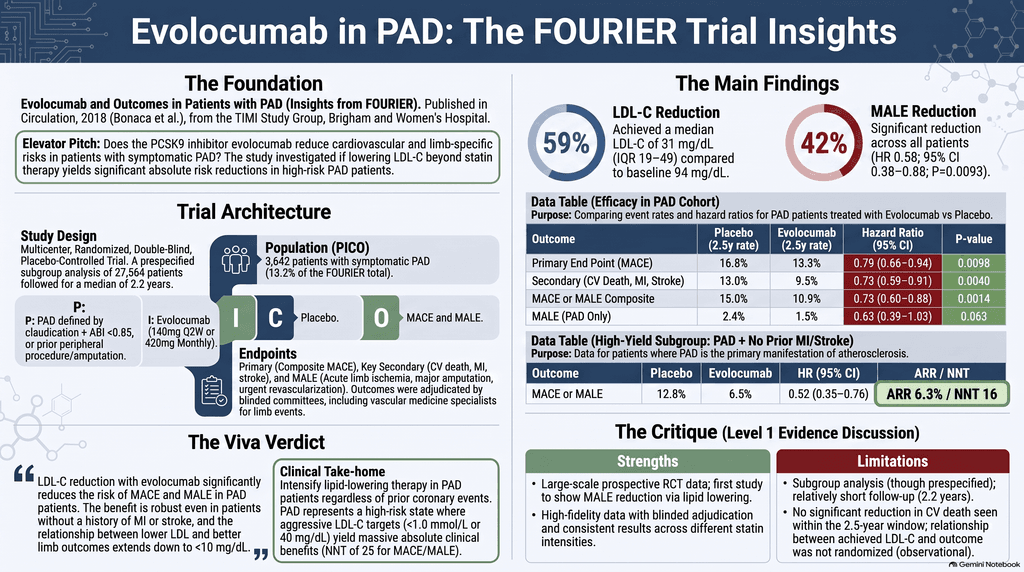
In high-risk patients with symptomatic lower-extremity PAD already receiving statin therapy, adding a PCSK9 inhibitor, evolocumab, produced profound LDL-C reduction, significantly reduced major cardiovascular events (HR 0.79, 3.5% absolute risk reduction [ARR], NNT = 29) and major adverse limb events (HR 0.58, 42% relative risk reduction). Because PAD patients had a higher baseline event rate, their absolute benefit was greater than in patients without PAD. Benefits extended down to LDL-C <10 mg/dL with no adverse safety trade-offs.
D. Research Question:
The investigators effectively asked two main questions:
- Does adding evolocumab to statin therapy reduce major adverse cardiovascular events in patients with PAD?
- Does intensive LDL-C lowering reduce major adverse limb events (MALE)?
E. Study Design & Location:
Prespecified Subgroup analysis of an international, multicentre (across 49 countries), randomised, double-blind, placebo-controlled phase III RCT.
F. PICO Criteria:
Population (number, inclusion & exclusion)
The parent FOURIER study randomised 27,564 patients:
- 3,642 (13.2%) had symptomatic lower-extremity PAD.
- Symptomatic PAD was defined as: intermittent claudication + ABI <0.85, previous peripheral arterial revascularisation, or previous amputation attributable to atherosclerosis.
- 1,505 had PAD without previous MI or stroke.
Inclusion:
- Age 40–85 years
- History of cardiovascular disease: previous MI, previous non-haemorrhagic stroke, or symptomatic PAD
- LDL-C ≥ 70 mg/dL (1.8 mmol/L) or non-HDL-C ≥100 mg/dL (>2.6mmol/L) on lipid-lowering treatment
- Background moderate/high-intensity statin therapy, with or without ezetimibe
Exclusion:
- MI or stroke within 4 weeks
- Planned cardiac/revascularisation procedure within 3 months
- Previous haemorrhagic stroke
- NYHA III/IV heart failure or LVEF <30%
- eGFR <20 mL/min/1.73 m²
- Uncontrolled hypertension
- Significant hepatic dysfunction.
Intervention (n = 1,858):
Evolocumab in addition to existing statin treatment.
Comparison (n = 1,784):
Placebo, plus statin therapy.
Outcome:
Primary composite (MACE) endpoint: cardiovascular death, myocardial infarction, stroke, hospital admission for unstable angina, or coronary revascularisation
Secondary outcomes:
1. Secondary composite endpoint: cardiovascular death, myocardial infarction, or stroke
2. Major adverse limb events (MALE) defined as acute limb ischemia, major amputation, or urgent peripheral revascularisation for ischemia
3. Combined MACE or MALE
G. Key Results:
| Patients with PAD | ||||
| Outcome | Placebo | Evolocumab | HR (95% CI) | Clinical effect |
| Primary (MACE) | 16.8% | 13.3% | 0.79 (0.66–0.94) | ARR 3.5%; NNT 29 |
| CV death/MI/stroke | 13.0% | 9.5% | 0.73 (0.59–0.91) | ARR 3.5%; NNT 29 |
| CV death | 3.8% | 4.0% | 1.02 (0.71–1.48) | No benefit |
| MI | 7.9% | 5.2% | 0.69 (0.52–0.91) | Reduced |
| Stroke | 3.1% | 1.8% | 0.59 (0.38–0.92) | Reduced |
| MALE | 2.4% | 1.5% | 0.63 (0.39–1.03) | Non-significant P=0.063 |
| MACE + MALE | 15% | 10.9% | 0.73(0.6-0.88) | ARR 4.1%;NNT 25 |
In the overall FOURIER population, evolocumab produced approximately a 42% relative reduction in MALE (HR 0.58, P = 0.0093). However, non-statistically significant reduction in the PAD subgroup (HR 0.63, P = 0.063)
Combined MACE + MALE:
PAD group: HR 0.73, ARR 4.1%, NNT = 25 over 2.5 years
PAD without previous MI/Stroke: HR 0.52, ARR 6.3%, NNT = 16
LDL-C effect
There was an approximately linear association between achieved LDL-C and MALE down to extremely low LDL values, with no obvious plateau.
Safety
There was no significant excess in overall or serious adverse events in PAD patients.
H. Related literature and background
The Heart Protection study (2006) provided evidence that statin therapy led to a 22% relative reduction in major vascular events in PAD. However, no evidence of a reduction in major limb events.
The original FOURIER trial showed that adding evolocumab to statins reduced cardiovascular events. However, this subgroup analysis checked whether this applied strongly in PAD patients and whether it also protected the limb.
ODYSSEY trail (2020) with a different PCSK9 inhibitor, alirocumab, supported the reduction in PAD events in patients with recent acute coronary syndrome.
FOURIER-OLE (2022) provided up to 8-year follow-up data from the FOURIER trial group. It demonstrated continued reduction in cardiovascular events and retained safety on long-term follow-up.
I. Critical Review & Opinions
Strengths:
- FOURIER was a large (27,564), double-blind, placebo-controlled RCT
- PAD sub-group was considerably well-sized (3,642), with pre-specified analysis
- Pragmatic intention-to-treat analysis
- Blinded adjudication with excellent agreement (K=0.903)
Criticism:
- Although sub-group was prespecified, the trail was not primarily powered as PAD-specific
- MALE in PAD alone was not statistically significant
- PAD without MI/ Stroke analysis was post-hoc and results cannot be fully regarded as definitive
- Short follow-up with a median of 2.2 years
- The trial did not reduce total peripheral revascularisations or elective interventions for claudication (HR 1.02, P=0.88)
- The study population represents stable symptomatic PAD rather than acute limb or CLTI
- Industry sponsored by Amgen (manufacturer of evolocumab)
J. Guidelines and application:
ECS & ESVS 2024 Lower-limb PAD guidelines recommend:
- LDL-C <1.4 mmol/L (<55 mg/dL) AND ≥50% reduction from baseline.
- If the LDL target is not achieved despite the maximum tolerated statin dose, guidelines suggest adding ezetimibe 10 mg daily, and if still above target, or if statins ± ezetimibe are not tolerated, consider a PCSK9 inhibitor
NICE guidance NG238 2023:
- Atorvastatin 80 mg for people with established CVD unless there is a reason to use a lower dose;
- A treatment target of LDL ‚ ≤2.0 mmol/L or non-HDL ‚ ≤2.6 mmol/L.
- If on maximum tolerated dose and intensity of statin, but the lipid target is not met, consider additional lipid-lowering treatments: alirocumab, evolocumab, ezetimibe, inclisiran.
K. Infographic:
L. FRCS Exam Station:
1. Clinical Scenario:
A 64-year-old female smoker with symptomatic intermittent claudication (ABI 0.62) and a prior femoropopliteal bypass presents to clinic. His lipid panel shows an LDL-C of 2.4 mmol/L (93 mg/dL) despite maximum tolerated atorvastatin 80 mg and ezetimibe 10 mg.
How would you optimise his medical management based on landmark evidence?
Suggested response:
This 64-year-old female vasculopath with previous history of revascularisation and continued smoking is at high risk of major cardiovascular and major adverse limb events. The Bonaca et al. subgroup analysis of the FOURIER PAD trial demonstrated that the use of a PCSK9 inhibitor in addition to a statin reduces both MACE & MALE events in PAD patients. I would recommend the addition of a PCSK9 inhibitor, such as evolocumab, in addition to smoking cessation to achieve an LDL-C target of <2.0mmol/L.
2. Service Scenario:
You are appointed as a consultant vascular surgeon, and you discover that many patients attending the vascular clinic at your new Trust are not reaching lipid targets.
How would you improve the service based on this study?
Suggested response:
This finding suggests suboptimal secondary prevention management in the new Trust. This is a clinical risk and a quality improvement opportunity. I would establish a quality improvement project to ensure a standardised ‘Vascular Secondary Prevention Lipid Pathway’ that enforces target-driven lipid titration to achieve strict guideline LDL cholesterol targets (<2.0 mmol/L). Under this pathway, all vascular patients will be regularly tested to ensure appropriate LDL management. The FOURIER PAD trial (Bonaca et al., 2018) demonstrated that in symptomatic PAD patients on background statin therapy, adding evolocumab reduced major adverse cardiovascular events (MACE) by 21%(ARR 3.5%, NNT = 29) over 2.5 years) and major adverse limb events (MALE), including acute limb ischemia, major amputations, and urgent revascularisations, by 42%. The pathway would ensure that patients on maximum-tolerated high-intensity statin and ezetimibe who remain above target are automatically screened and started on PCSK9 inhibitor therapy.