
Authors: C Baigent at al, Cholesterol Treatment Trialists’ (CTT) Collaboration 1; Lancet 2010 Nov 13;376(9753):1670-81. doi: 10.1016/S0140-6736(10)61350-5
https://www.thelancet.com/article/S0140-6736(10)61350-5/fulltext
#Secondary Prevention in Peripheral Vascular Disease
A. Period of study (start – end):
Included trials were published from 1994-2009
B. Publication date & Journal:
November, 2010
The Lancet
Journal Impact Factor (2025): 109.0
C. TL;DR (Bottom Line)
Lower LDL cholesterol levels are better in patients at risk of vascular occlusive disease. Every additional 1 mmol/L reduction in LDL cholesterol resulted in approximately a fifth (22%) proportional reduction in major vascular events (Coronary death, MI, Ischaemic Stroke), 10% reduction in all-cause mortality, and 14% reduction in vascular mortality, with continued benefits below 2mmol/L LDL lower reference mark.
D. Research Question:
Whether achieving a larger reduction in LDL cholesterol with intensive statin therapy results in an additional reduction in major vascular events without causing further hazard(cancer or haemorrhagic stroke).
E. Study Design & Location
Individual patient data (IPD) meta-analysis of randomised control trials prior to 2009.
Studies: International, multicentre
CTT collaboration:
- Clinical Trial Service Unit and Epidemiological Studies Unit, University of Oxford, UK
- NHMRC Clinical Trials Centre, University of Sydney, Australia.
F. PICO Criteria:
Population (number, inclusion & exclusion):
- Meta-analysis of 169,138 participants across 26 international trials
- Trial inclusion: LDL cholesterol lowering with statin, no other risk-factor modification, minimum 1,000 participants, 2 years’ treatment period
- Trial Exclusion: pre-planned coronary revascularizations occurring within 30 days of randomisation were systematically excluded
Intervention:
- More intensive LDL cholesterol lowering using statin
Comparison:
- Less intensive statin therapy
- Placebo/ usual care/ no statin
Outcome (primary, secondary & subgroup):
- Primary: first major vascular event (any major coronary event, coronary revascularisation, or stroke)
- Secondary: coronary death, non-fatal myocardial infarction, coronary revascularisation, CABG, angioplasty, ischaemic stroke, haemorrhagic stroke, overall stroke, cause-specific mortality, all-cause mortality, cancer incidence and cancer mortality.
- Subgroups: compared baseline characteristics- previous vascular disease, diabetes, sex, age, hypertension, systolic and diastolic BP, BMI, HDL, smoking, renal function/eGFR, and baseline LDL concentration.
G. Related literature and background
First CTT collaboration study (90,000 participants, 14 trials, published in 2005) already suggested lowering LDL by approximately 1 mmol/L reduced major vascular events by about one fifth.
Knowledge gap: However, these studies did not answer the question for patients already on a statin with low LDL: is there additional benefit from further lowering LDL cholesterol?
Only two of the five intensive-treatment RCTs at the time had individually demonstrated statistically significant primary outcomes.
There were safety concerns regarding intensive statin treatment causing: cancer, haemorrhagic stroke, non-vascular death and myopathy.
H. Critical Review & Opinions
Strengths:
- Large number of participants, approx. 170k
- IPD analysis- allowed meta-analysis to standardise endpoints, subgroup analysis, individual risk factors and time-to-event analysis
- CTT protocol was agreed prior to release of results, reducing biases in analysis
- Intention-to-treat analysis is pragmatic
Criticism:
- Inherits limitations of a meta-analysis, i.e. Heterogeneity of analysed studies
- 3 eligible trials did not contribute individual participant data:
- CORONA, SPARCL and GREACE — together involving 11,342 patients
- SPARCL, for example, identified inc. haemorrhagic stroke risk
- Safety assessment of statins showed increased risk of rhabdomyolysis with simvastatin 80mg. No comprehensive assessment of other non-fatal adverse effects of statins, such as: muscle symptoms or liver enzyme abnormalities.
- The study found a 25% proportional reduction in major vascular events per 1mmol/L LDL reduction amongst the primary prevention sub-group with no previous vascular disease. However, this subgroup analysis did not include the five intensive-vs-standard statin trials, which consisted predominantly of patients with established coronary disease. Therefore, use of intensive statin treatment, lacks generalisability in low-risk primary prevention.
- Most of the constituent trials had received pharmaceutical-industry research funding.
- In the primary IPD analysis of 26 trials, there was a non-significant excess of haemorrhagic strokes in the statin group. However, in the aggregate data, including the SPARCL & CORONA trials, which did not provide IPD data, the combined meta-analysis found a significant rate ratio of 1.21 per 1.0 mmol/L reduction in LDL cholesterol. However, the absolute hazard of haemorrhagic stroke was 50-fold smaller than the benefit from major vascular event prevention.
I. Guidelines and application:
Current NICE guidance for secondary prevention of CVD recommends:
- atorvastatin 80 mg for people with established CVD unless there is a reason to use a lower dose;
- a treatment target of LDL ≤2.0 mmol/L or non-HDL ≤2.6 mmol/L.
The 2024 ESVS PAD guideline summarises the vascular BMT lipid target as:
- LDL-C <1.4 mmol/L (<55 mg/dL) AND ≥50% reduction from baseline.
- If the LDL target is not achieved despite the maximum tolerated statin dose, guidelines suggest adding ezetimibe 10 mg daily, and if still above target, or if statins ± ezetimibe are not tolerated, consider a PCSK9 inhibitor
J. Infographic
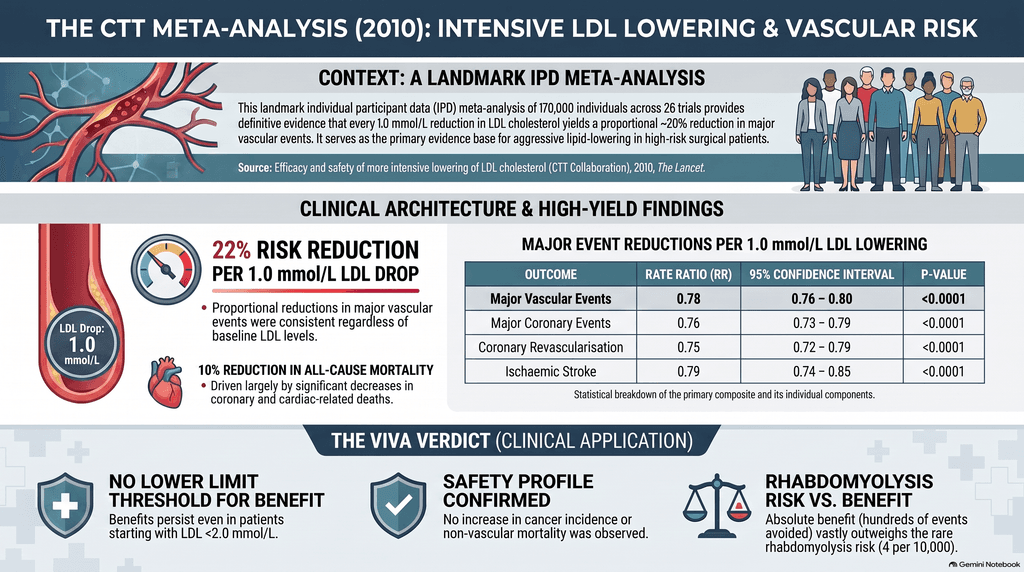
K. FRCS Exam Station:
1. Clinical Scenario:
A 68-year-old man with a history of short-distance claudication presents to your clinic. He has hypertension and previous coronary disease. His LDL is 2.4 mmol/L while taking simvastatin 20 mg.
How would you advise him on the best medical management based on this study?
Suggested response:
This 68-year-old gentleman is at extremely high risk of recurrent major vascular events due to his polyvascular disease presenting as symptomatic peripheral arterial disease with claudication and previous coronary artery disease. He has suboptimal control of his LDL at 2.4mmol/L while on simvastatin. The CTT individual-patient meta-analysis demonstrated that every 1 mmol/L reduction in LDL produces approximately a 22% proportional reduction in major vascular events, with additional benefit even when LDL is already below 2 mmol/L. Based on these findings, I would like to optimise this patient’s secondary prevention by transitioning him to more intensive lipid-lowering therapy. I would achieve this by switching his statin from simvastatin, which has an increased risk of rhabdomyolysis, to atorvastatin 80 mg per day, and by monitoring his Lipid profile regularly to ensure the target of < 2.0 mmol/L LDL cholesterol is achieved.
2. Service/ Management improvement Scenario:
An audit of your vascular unit finds that only 55% of patients discharged following lower-limb revascularisation are receiving appropriate lipid-lowering therapy.
How would you improve this service based on this study?
Suggested response:
I would design a standardised ‘Vascular Secondary Prevention Lipid Pathway’ where every patient admitted for an arterial intervention is automatically transitioned to high-intensity lipid therapy (e.g., Atorvastatin 80 mg or Rosuvastatin 20 mg daily) prior to discharge, rather than relying on primary care referrals. The CTT meta-analysis demonstrated that every 1.0 mmol/L reduction in LDL cholesterol translates to a 22% reduction in major vascular events. This benefit is maintained even in patients with starting LDL of below 2.0mmol/L without any significant increase in adverse events.
3. Study Design Scenario:
The CTT study was published in 2010.
Based on current practice of lipid lowering, how would you design a new study in current era?
Suggested response:
The 2010 CTT Collaboration is widely considered the gold standard (Level 1) of evidence for lipid-lowering because it is a meta-analysis of individual participant data (IPD) from RCTs. The meta-analysis established that “lower is better” with standard and high-dose statins, showing a consistent 22% reduction in major vascular events per 1.0 mmol/L reduction in LDL. However, the study does not reflect current-era practice with the addition of non-statin therapies (such as Ezetimibe and PCSK9 inhibitors/ inclisiran). I would propose a multi-centre, double-blinded, randomised controlled trial designed to test the ‘ultra-low LDL’ hypothesis in high-risk vascular patients. I would test whether combination therapy would produce further relative risk reduction in major vascular events compared to standard high-intensity statin monotherapy, without increasing safety hazards.